
The AI Avant-Garde: 20 Artists Redefining Creativity with Artificial Intelligence
Art
Oct 11
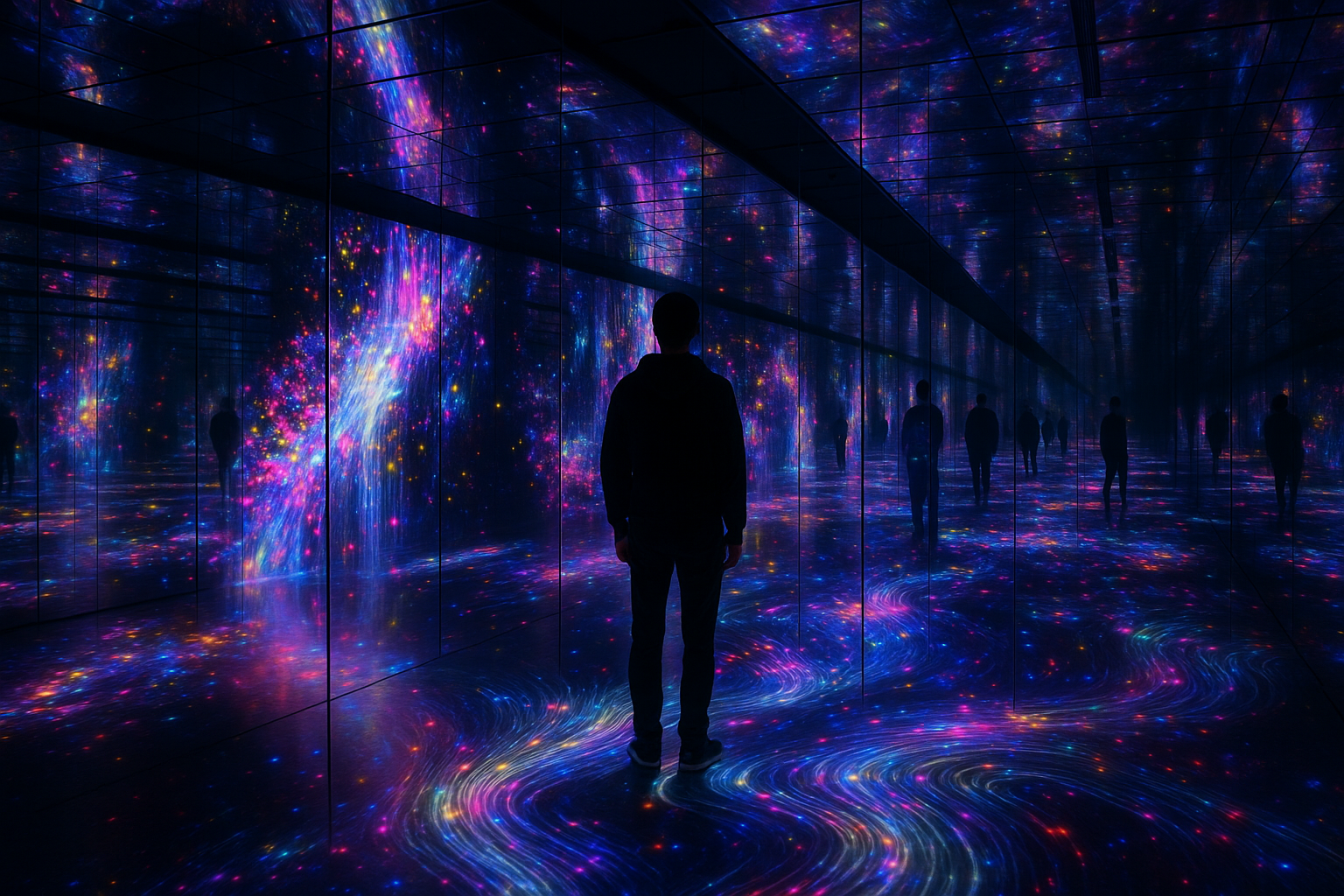
The lineage of immersive art installations can be traced back to the radical art practices of the 1960s, notably Allan Kaprow’s pioneering “Happenings.” Kaprow’s performative, ephemeral events emphasized the dissolution of traditional spectator roles, inviting active participation and foregrounding temporality and spatiality (Kaprow, 1966). These early experiments destabilized the boundaries between artwork and audience, presaging contemporary immersive experiences. Parallel to this, installation art emerged as a medium that enveloped the viewer within constructed environments, advancing from minimalist spatial interventions in the 1960s (Meyer, 2000) to multi-sensory narratives in the late 20th century.
The conceptual framework of Nicolas Bourriaud’s Relational Aesthetics (1998) further theorized the social dimension of art, positing that artworks could be sites of intersubjective encounters rather than isolated objects. Bourriaud emphasized art as a catalyst for human interaction and social exchange, a philosophy foundational to immersive exhibitions that prioritize participatory engagement. The transition from Happenings’ performative immediacy to the complex digital installations of the 21st century marks a technological and conceptual evolution, reflecting broader shifts in media, audience expectations, and institutional curation.
Founded in Tokyo in 2001, teamLab is a pioneering collective of over 500 members encompassing artists, programmers, engineers, and architects. Their signature project, teamLab Borderless, opened in 2018 in Tokyo and exemplifies the synthesis of art and cutting-edge technology. Spanning approximately 10,000 square meters, the installation employs an intricate network of 520 computers and 470 projectors to create dynamic, interactive environments where digital artworks flow seamlessly across walls, floors, and ceilings (teamLab, 2018).
Technical mechanisms include advanced projection mapping and interactive sensors that respond in real-time to visitor movement, enabling a “living” ecosystem of art that evolves with human presence. For example, flowers bloom on the floor as visitors walk, while koi fish swim away when approached. This continuous feedback loop between artwork and participant embodies Bourriaud’s relational aesthetics by fostering immersive social interactivity within a digital domain. teamLab’s success, attracting millions globally, signals a paradigm shift towards art as an algorithmically mediated experience rather than static objecthood.
Since the 1960s, Japanese artist Yayoi Kusama has explored themes of infinity, self-obliteration, and hallucination through her iconic Infinity Mirror Rooms. Utilizing mirrored walls, LED lights, and limited spatial volumes, these installations create the illusion of boundless space, inviting viewers into environments that challenge perceptions of self and cosmos (Kusama, 1965–present). Kusama’s work is historically grounded in Minimalism and Pop Art, yet her immersive installations transcend genre by merging psychological interiority with physical experience.
Contemporary iterations employ sophisticated LED technology and controlled lighting sequences, often resulting in hours-long wait times at major institutions—testament to their cultural resonance and demand. For instance, the 2017 exhibition at The Broad Museum in Los Angeles reported wait times exceeding four hours, with visitor counts numbering in the hundreds of thousands (The Broad, 2017). Kusama’s Infinity Rooms epitomize the affective power of immersive art to evoke emotional and existential reflection through spatial manipulation.
Founded in Santa Fe in 2008, Meow Wolf is a collective that integrates immersive art with narrative storytelling, creating expansive, multi-sensory environments that blend sculpture, architecture, and digital media. Their flagship installation, The House of Eternal Return, launched in 2016, features a nonlinear narrative that visitors uncover through exploration, emphasizing agency and discovery (Meow Wolf, 2016).
Technically, Meow Wolf installations combine handcrafted physical sets with augmented reality and interactive elements, enabling a multi-layered experience. This approach contrasts with purely technology-driven projects by privileging tactile engagement and narrative depth. Meow Wolf’s success—evidenced by millions of visitors and expanded venues in Denver and Las Vegas—demonstrates the viability of immersive art as a site of communal storytelling, challenging traditional museum modalities.
The Van Gogh Immersive exhibition exemplifies the commodification and popularization of immersive art. Since its inception in 2016, it has attracted over four million visitors worldwide, offering large-scale, projection-mapped animations of Van Gogh’s oeuvre accompanied by curated soundscapes (Van Gogh Immersive, 2023). The exhibition utilizes over 140 projectors in spaces exceeding 2,000 square meters to envelop visitors in pulsating fields of color and texture.
While lauded for democratizing access to canonical art, Van Gogh Immersive has also sparked critical debates regarding “Instagram art” and spectacle-driven consumption. Critics argue that the emphasis on photogenic moments risks overshadowing critical engagement with the artist’s historical and cultural contexts (Jones, 2020). Nonetheless, its commercial success underscores the growing demand for immersive formats within popular culture and the art market.
Established in 2015, ARTECHOUSE is a pioneering U.S.-based platform dedicated to showcasing immersive digital art that leverages emergent technologies such as projection mapping, interactive sensors, and spatial audio. Exhibitions like Machine Hallucinations by Refik Anadol (2019) exemplify ARTECHOUSE’s commitment to exploring the intersection of data, machine learning, and human perception.
The technical infrastructure involves high-resolution projectors, LIDAR sensors, and custom software that allows artworks to respond dynamically to visitor movement and ambient conditions. ARTECHOUSE’s institutional model emphasizes accessibility, seeking to bridge the gap between high art and technology enthusiasts. Their exhibitions have drawn tens of thousands of visitors annually, signaling a growing public appetite for technologically mediated art experiences.
The Rain Room, developed by the art collective Random International in 2012, is a seminal example of immersive installation that merges technology with natural phenomena. Spanning approximately 100 square meters, the installation uses 3D tracking cameras and motion sensors to create a controlled environment where visitors walk through continuous rainfall that pauses wherever their bodies are detected (Random International, 2012).
This precise interplay between human presence and environmental manipulation invites reflection on the human-nature relationship and the mediation of experience through technology. The Rain Room has been exhibited at major venues including the Barbican Centre (London) and MoMA (New York), where it attracted large audiences and stimulated discourse on the authenticity of artificially generated natural experiences within art contexts.
Turkish-American artist Refik Anadol has emerged as a leading figure in data-driven immersive art, employing machine learning algorithms to transform massive datasets into dynamic, site-specific installations. His project WDCH Dreams (2018) at the Walt Disney Concert Hall utilized over 100 terabytes of archival images processed through neural networks to animate the building’s façade with fluid, abstract visuals (Anadol, 2018).
Anadol’s work exemplifies a synthesis of art, architecture, and AI, interrogating the potentials and limits of algorithmic creativity. The technical apparatus includes GPU-accelerated computation, generative adversarial networks (GANs), and high-resolution LED displays. His installations challenge conventional notions of authorship and materiality, expanding the discourse on immersive art’s future trajectories amid increasing digital automation.
The proliferation of immersive art installations coincides with the rise of social media platforms, particularly Instagram, which has profoundly shaped artistic production and reception. The phenomenon of “Instagram art”—works designed or framed primarily for photogenic appeal—has elicited critical debate about authenticity, commodification, and the experiential integrity of art (Gosling & Kwon, 2019).
While social media exposure has democratized access and expanded audiences, it also risks reducing complex works to mere backdrops for self-presentation. This tension is evident in exhibitions like Kusama’s Infinity Rooms and Van Gogh Immersive, where visitor behavior often prioritizes documentation over contemplation. Institutions and artists grapple with balancing accessibility and depth, negotiating the dual imperatives of visibility and critical engagement in the digital era.
Major institutions such as MoMA, Tate Modern, and the Guggenheim have increasingly incorporated immersive and experiential formats into their programming, recognizing their capacity to attract diverse audiences and foster new modes of engagement (MoMA, 2022; Tate, 2023). This institutional adoption reflects an evolving museological paradigm that prioritizes multisensory and participatory encounters alongside traditional modes of art historical scholarship.
Nevertheless, this shift raises critical questions about the balance between spectacle and contemplation, entertainment and education. The challenge lies in integrating immersive technologies without sacrificing critical rigor or diluting artistic complexity. Future museum practices will likely involve hybrid models, combining digital interactivity with contextual frameworks that encourage sustained reflection. As immersive art continues to evolve, its role within cultural institutions will necessitate ongoing negotiation between innovation, accessibility, and intellectual depth.

