
The Highest Towns in Europe: Where Elevation Meets Charm
Land
Oct 10
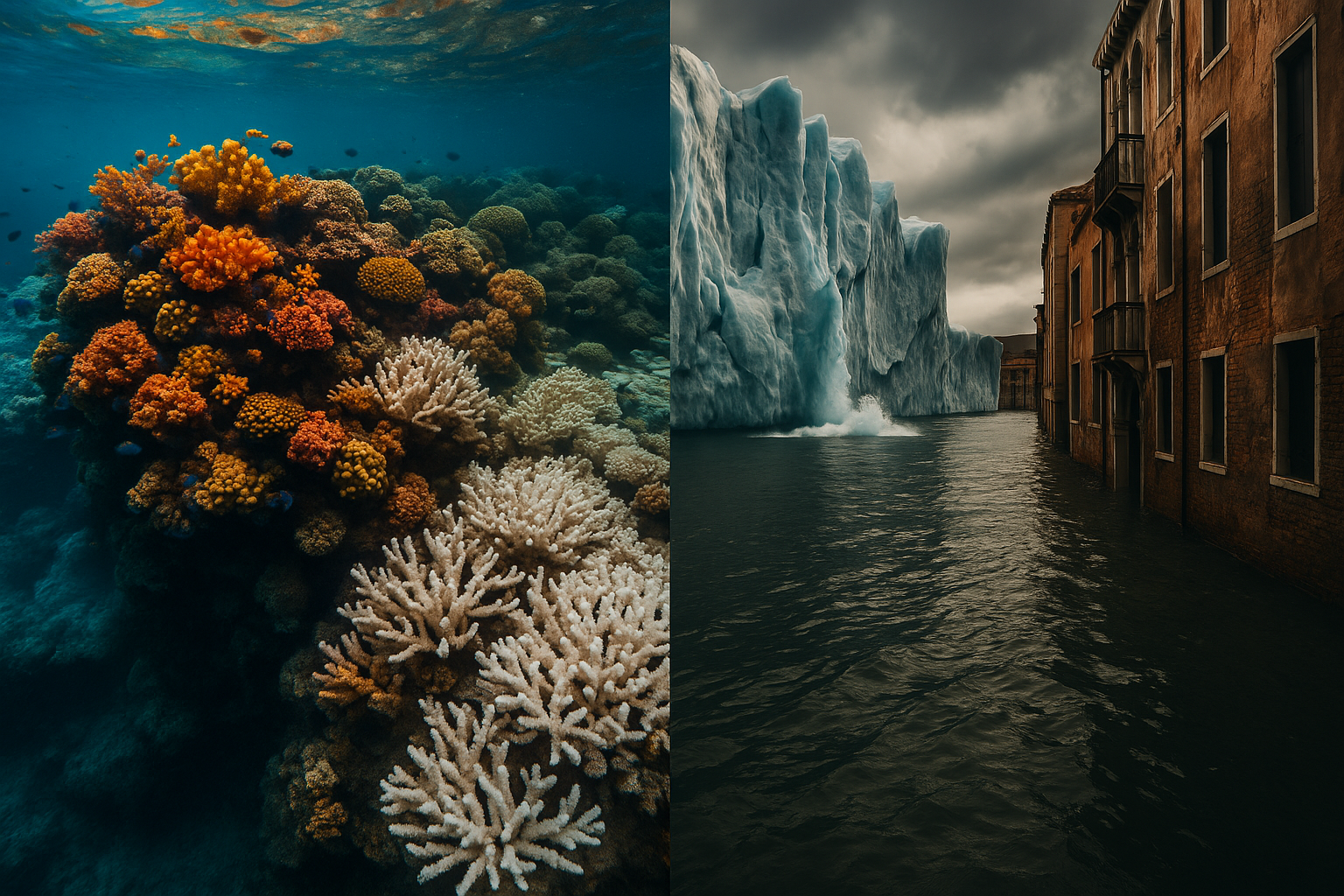
The Great Barrier Reef (GBR), spanning over 2,300 kilometers along Australia's northeast coast, represents the world's largest coral ecosystem and a UNESCO World Heritage Site. However, it faces unprecedented threats from climate change, primarily through ocean warming and acidification. Scientific evidence from extensive monitoring reveals three major mass coral bleaching events in 2016, 2017, and 2020, each linked to anomalously high sea surface temperatures (Hughes et al., 2017; Hughes et al., 2019; Hughes et al., 2021). These events caused widespread coral mortality, with the 2016 bleaching affecting approximately 91% of reefs surveyed and the 2020 event exacerbating the cumulative stress on reef resilience.
Mechanistically, elevated sea temperatures disrupt the symbiotic relationship between corals and their photosynthetic zooxanthellae, leading to bleaching. Concurrently, increasing atmospheric CO2 concentrations, now exceeding 420 ppm, have increased oceanic CO2 uptake, causing ocean acidification. The resulting decrease in carbonate ion concentration impairs calcification processes vital for coral skeleton formation (Kleypas et al., 2006). The Intergovernmental Panel on Climate Change (IPCC) Sixth Assessment Report projects global sea surface temperature increases of 1.5–2.0°C by 2050 under intermediate emissions scenarios (IPCC, 2023), suggesting continued threat to the GBR’s integrity.
Conservation efforts include coral restoration programs employing selective breeding for heat-resistant genotypes and assisted gene flow (van Oppen et al., 2015). Additionally, local management reduces stressors such as pollution and overfishing to bolster reef resilience. Nevertheless, global mitigation remains critical to prevent further degradation.
The Maldives archipelago comprises approximately 1,190 low-lying coral islands in the Indian Ocean, with an average elevation of merely 1.5 meters above sea level (UNEP, 2018). This topography renders the nation exceptionally vulnerable to sea level rise induced by thermal expansion of oceans and melting of terrestrial ice (Church et al., 2013). The IPCC projects a global mean sea level rise between 0.28 and 0.55 meters by 2100 under moderate emission scenarios (RCP4.5), with possibilities exceeding one meter under high emissions (RCP8.5) (IPCC, 2023).
The resultant impacts include increased frequency and intensity of coastal flooding, salinization of freshwater resources, and loss of habitable land, threatening the Maldives' very existence. Scientific studies document a mean sea-level rise rate of approximately 3.7 mm/year in the region over recent decades (Nerem et al., 2018).
To mitigate these risks, the Maldivian government invests in adaptive infrastructure such as sea walls and artificial islands, exemplified by the Hulhumalé reclamation project. International cooperation aims to reduce emissions globally, while local initiatives promote sustainable tourism to limit carbon footprints.
Venice, Italy, renowned for its historic canals, is increasingly plagued by "acqua alta" (high water) events. Historically, flooding occurred approximately seven times annually in 1900; however, recent data indicates more than 60 events per year, with 2022 witnessing unprecedented frequency (Venice Municipality Report, 2023). This escalation arises from relative sea level rise driven by global oceanic thermal expansion, glacial meltwater input, and local subsidence (Carbognin et al., 2014).
The MOSE (Modulo Sperimentale Elettromeccanico) project, an extensive system of mobile flood barriers installed at the lagoon's inlets, aims to protect Venice by temporarily isolating the city during surge events. While MOSE has been operational since 2020, its efficacy depends on maintenance and timely deployment; moreover, it does not address the root causes of sea level rise (Venice MOSE Authority, 2023).
Venice’s challenges epitomize the complex interplay between natural processes and anthropogenic influences, underscoring the necessity for integrated climate adaptation and mitigation strategies.
Glacier National Park (GNP) in Montana, USA, once harbored approximately 150 glaciers in 1850, a period marking the end of the Little Ice Age (Hall and Fagre, 2003). By 2020, only 26 glaciers met the criteria of active ice masses larger than 25 acres, signifying a dramatic retreat attributed to regional warming trends exceeding 1.2°C since the early 20th century (Fagre et al., 2017).
Glacial retreat arises from enhanced ablation rates driven by increased air temperatures and altered precipitation regimes. Additionally, feedback mechanisms such as decreased albedo accelerate melting (Pelto, 2017). The IPCC anticipates further warming with potential near-complete loss of small mountain glaciers globally by 2100 under high emission scenarios (IPCC, 2023).
Monitoring programs in GNP utilize remote sensing and in situ measurements to track glacier dynamics, informing conservation and visitor education. The park has implemented visitor limits in sensitive areas to reduce anthropogenic stress.
The Amazon Basin, encompassing 5.5 million square kilometers, is a critical carbon sink and biodiversity hotspot. However, deforestation driven by logging, agriculture, and infrastructure development has accelerated, with an estimated 17% loss of forest cover since the 1970s (INPE, 2022). This loss threatens to push the ecosystem toward a tipping point, shifting from rainforest to savannah-like conditions (Lovejoy and Nobre, 2018).
Climate change exacerbates these dynamics through altered precipitation patterns and increased drought frequency, weakening forest resilience. The combined effects risk a feedback loop where reduced carbon sequestration accelerates atmospheric CO2 accumulation (IPCC, 2023).
Conservation initiatives include protected area expansion, indigenous stewardship, and reforestation projects. International funding mechanisms such as REDD+ aim to incentivize forest preservation and sustainable livelihoods.
The Dead Sea, a hypersaline lake bordered by Jordan, Israel, and Palestine, has experienced a volume reduction exceeding 30% since the 1960s due to water diversion from the Jordan River and increased evaporation associated with regional climate warming (Al-Quraan et al., 2018). Its surface elevation has dropped by over 25 meters, exposing sinkholes and threatening ecological and economic systems.
Thermal expansion contributes marginally, but anthropogenic water withdrawals dominate. The IPCC acknowledges regional variability in hydrological cycles, with projections indicating increased aridity in the Middle East (IPCC, 2023).
Projects such as the Red Sea–Dead Sea Water Conveyance aim to stabilize water levels by introducing seawater, though ecological risks remain under evaluation.
Antarctica, Earth's southernmost continent, contains approximately 90% of the planet's ice mass. Recent satellite observations document significant ice mass loss, particularly in the West Antarctic Ice Sheet, contributing to global sea level rise (Rignot et al., 2019). Mechanisms include basal melting from warmer ocean waters and atmospheric warming increasing surface melt (Schmidt et al., 2018).
The IPCC projects Antarctic contributions to sea level rise between 0.03 and 0.12 meters by 2100 under varying emission trajectories, with potential for nonlinear responses if marine ice sheet instability thresholds are exceeded (IPCC, 2023). These dynamics represent critical uncertainties in global climate projections.
Antarctic Treaty System frameworks regulate scientific activity and tourism, emphasizing preservation. However, increasing accessibility poses emerging environmental management challenges.
Travel to climate-threatened destinations must reconcile economic benefits with environmental stewardship. Responsible tourism practices focus on minimizing carbon footprints, supporting conservation, and respecting local cultures and ecosystems.
Carbon offset programs offer partial mitigation by funding renewable energy, reforestation, or community projects, though their efficacy depends on verifiable and additional emissions reductions (Gössling et al., 2020). Visitor limits and permit systems reduce overtourism pressures, as exemplified by regulated access to sensitive reef sites and protected areas.
Sustainable practices include utilizing low-impact transportation, engaging with locally managed ecotourism initiatives, and adhering to guidelines that prevent habitat disturbance and pollution. Educational efforts enhance traveler awareness of climate impacts and conservation needs.
Integrating scientific knowledge and adaptive management ensures that tourism can contribute positively to the preservation of these vulnerable destinations amid accelerating climate change.
